




The History of Esterbrook
The Indestructible Writing Companion
The Esterbrook name marks an important chapter in American pen making. The brand progressed from steel dip nibs to durable, colorful, easily repaired celluloid fountain pens. Its replaceable Renew Point nibs, along with the legendary Dollar Pen and J models, remain sought-after, highly usable fountain pens today.

The name Esterbrook derives from the Old English words ēast (east, eastern) and brōc (brook, stream). Literally it means "eastern brook," and as a locative/topographic surname it means "a person living by the eastern brook." It developed as a place name and family name in England (especially in the county of Devon). The brand was named after its founder, Richard Esterbrook (1813–1895), an English-born (Cornish) Quaker* merchant who emigrated to the United States in 1858 and founded The Esterbrook Steel Pen Manufacturing Company in Camden, New Jersey. The company had to develop nearly everything itself, from the alloy to the machinery and the polishing. Esterbrook soon became one of the characteristic success stories of American industry. The range, which started with ten nib types, grew to 150 by 1904, 250 by 1907, and roughly 400 variants by the 1920s. Esterbrook of Camden and the C. Howard Hunt Pen Company, also based there (whose nibs can be found in Hungarian pens as well), together once produced the overwhelming majority of the world's steel nibs.
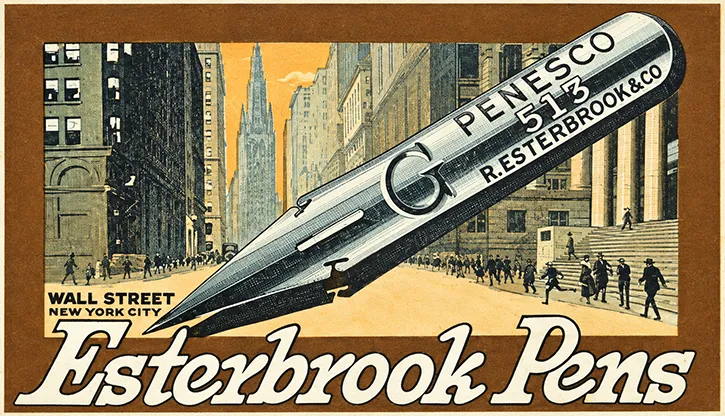
For more than half a century, Esterbrook made mainly steel dip nibs. Its own pen holders appeared around 1928, and fountain pens from the late 1920s onward. The earliest known examples were made of black hard rubber: both American eyedropper and English lever-filler versions survive, with 14-karat gold nibs. The brand's true fountain pen era, however, began in the 1930s with lever-filling models made of colorful Pyralin plastic. Pyralin (or Ivory Pyralin) is the brand name of one of the earliest nitrocellulose-based plastics (celluloid), which DuPont made known worldwide in the early 1900s and the 1920s.
The decisive innovation was the Re-new-point, later spelled Renew Point. The nib and the feed formed a single threaded unit made up of 3 parts, which could be unscrewed from the section and swapped for another. The basic idea came from the world of dip pens, where the nib could be replaced in a matter of moments. Likewise, a fountain pen did not have to be taken to a specialist if the nib was damaged. With a few movements it could be replaced with a new one, or exchanged for a nib with a different line width, flexibility, or a shorthand, bookkeeping or calligraphic character. Esterbrook carried the experience it had accumulated with dip nibs directly over to fountain pens: the range eventually covered 33 writing styles. Besides the 1000 and 2000 Duracrome series, 3000 series nibs with an iridium-like tip, and later the more carefully made 9000 Master Point nibs, were also produced. Interchangeability remains the most important practical advantage of older Esterbrook pens to this day, but it is also a drawback: if we insist on keeping the original nib and the feed channels are completely clogged, mechanical cleaning is rather awkward because of the compact nature of the nib unit (but not impossible).
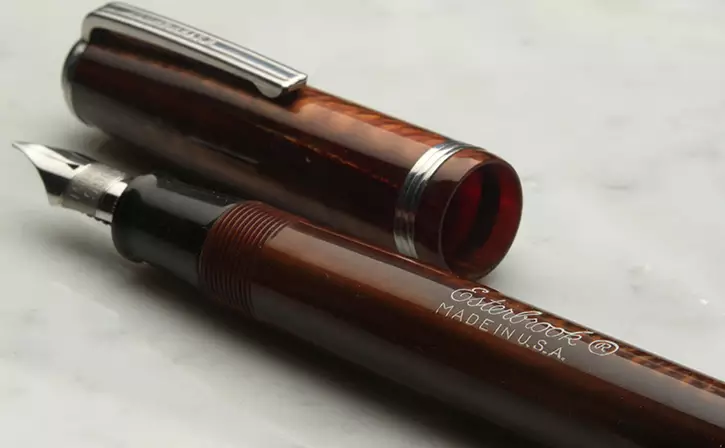
The Dollar Pen appeared in 1935 and, true to its name, was available from one dollar. Besides the basic black model, there were pricier marbled colors, Morocco Red, Foliage Green and Pearl Gray, and as injection molding advanced, further vivid shades and sizes followed. The Dollar Pen offered a simple but durable construction, good plastic, and an easily repaired lever filler with a rubber sac. It did not aim to be a luxury item but an affordable, reliable writing instrument that held its own against more expensive rivals in writing quality.
The raw material restrictions of the Second World War produced a special version. The twist-filling pen, with no rubber sac or lever, received a streamlined cap, a clip with reduced metal content, and a nib made of a 12-karat palladium alloy instead of steel. After the war the lever-filling system returned, but the new shape remained. Around 1948–1949 the barrel end closed with a ring and a black button took shape, along with the well-known J family. Besides the full-size J, the long, slim LJ, the shorter SJ, the white Nurse Pen and the small, pastel-colored Purse Pen appeared. The Deluxe with a chrome cap targeted the market of metal-capped pens.
In the 1950s Esterbrook no longer made only classic lever-filler fountain pens. The Plunger-Fill drew ink directly into the sacless barrel, the Safari worked with one long or two short cartridges, and an aerometric version was also made. The company tried to adapt to the market with ballpoint pens, among them the Wordathon and the Scribe. At the peak of its production it turned out as many as 600,000 pens a day, and in 1957 it was regarded as the leading supplier of office pen sets.
The rise of the cheap ballpoint pen, rising costs and growing competition weakened the company by the 1960s. In 1964 production moved from Camden to Cherry Hill, in 1967 the Venus-Esterbrook Co. was formed, and in 1971 production ceased. The historic Camden factory was demolished a year later.
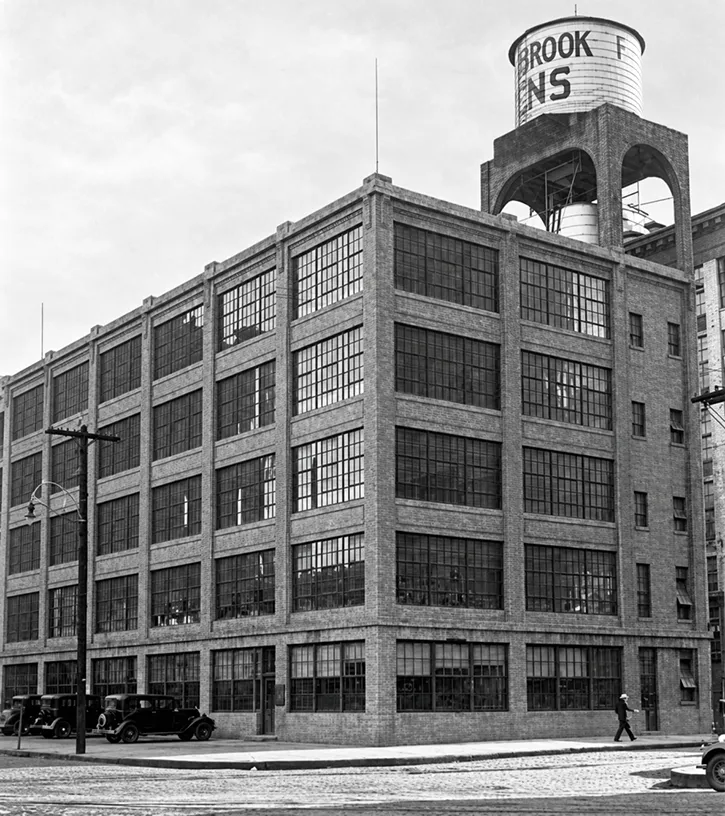
Old Esterbrook fountain pens are popular primarily because the color of their Pyralin plastic often survives excellently and vividly even after many decades, their construction is simple, their parts are repairable, and they are sturdy and hard to break. As a pen repairer, I have never come across a cracked Esterbrook barrel or a failed filling mechanism. More than once I have come across original factory sacs from the 1950s, in flawless condition and bearing the brand imprint!
* The Quakers (officially the Religious Society of Friends) are members of a radical Protestant Christian denomination that arose in England in the mid-17th century.
Tamás Szűcs / October 2026