




The pen maker honoured with a marble plaque
Sören Christian Frederik Olsen is perhaps the first fountain pen manufacturer to have been honoured with a memorial plaque by a grateful posterity. If you own an old Parker pen, it may have been distributed by this Copenhagen businessman. He was Parker’s first distributor on the European continent, operating from 1903 to 1963. This began with an agreement between George S. Parker and Soren Christian Olsen as the American company sought to expand into Europe. These are the so-called Danish Parker pens.

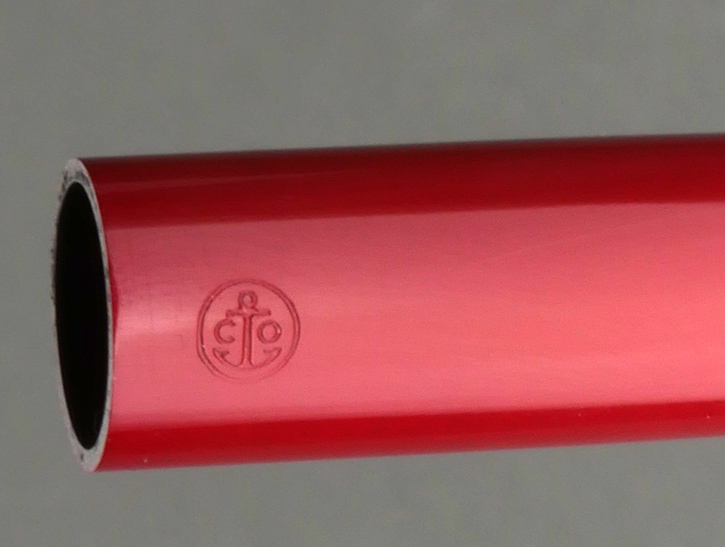
They are identified by the barrel-shaped initials "CO" (Chr. Olsen) and an "anchor" inside a circle (also found on Penol pens). The anchor symbolises Chr. Olsen's passion for sailing. Other Parker fountain pens are marked "MID" (Made in Denmark). A Danish Parker nib may also bear the "D" (Denmark) or "NGI" (Nordisk Guldepenne Industri). Interestingly, Canadian Parker pens have occasionally been sent to Denmark for resale and these pens bear both the Canadian mark and the CO anchor logo. Furthermore, in Germany, when Parker - Osmia production ceased and the factory closed in 1930, a number of Parker - Osmia pens were sent to Denmark for sale. The ‘Parker–Osmia AG Heidelberg’ inscription was sanded off and replaced with Olsen’s anchor logo.
In the early 1930s, Chr. Olsen began to manufacture his own pens under the name Penol. The brand name was born from the combination of pen and Olsen. In the early 1930s, Penol pens, made in Copenhagen, were more successful than imported Parker pens. This was confirmed by the company's intensive advertising campaign.

Penol pens were assembled by hand. Some were made with Parker parts, and some Parker pens also contain Penol parts. During the war period, there was a shortage of raw materials (especially gold), but the use of gold was not greatly reduced, preserving the exclusivity of Penol pens. During the German occupation, most pens in Denmark were black, but the most popular were the red, “national” Penol pens, symbolising the Danish flag. Oddly enough, American pens continued to be produced during the German occupation.
Their popularity among pen collectors was mainly due to their high quality and attractive design. Penol produced a number of different top models between 1930 and 1950. Initially, Penol used a numbering system (No. 1, No. 2, No. 3). The pens were similar in construction to Parker Duofolds. The most popular and widely produced and distributed Penol models were the earlier Deluxe models (O, AO, BO and CO) and the later Ambassador series (Junior, Special and Senior). Although little information is available on how many pens Penol produced, many unique models and limited editions were made in Copenhagen. In the late 1940s, Penol developed a good relationship with the American company Esterbrook, and there are clips and nibs with Esterbrook inscriptions on Penol pens. In the 1950s and 1960s, Penol started producing school stationery under the name Skolepen. Cheap ballpoint pens severely reduced fountain pen sales. Although it produced a few ballpoint pen models (Q-pen, Q-pen Twin and Q-nylon), the factory had to stop producing fountain pens in 1966. Today Penol pens are rare in pen collections.
